Friday, June 15, 2018

Tower Roof Tweaked


I think I mentioned a few blogs ago that I did not like the way the aging on the copper roof of the tower ended up. Here is what it looked like:
If you click the photo for a larger version, it is easy to see how the salt caked and built up on the surface. It just didn't look right.
I used a plastic scrubber sponge and rubbed off the salt crystals on the left side. I liked the difference. It looks more like a copper roof that is aging naturally.


When it was all dry scrubbed, I used a damp paper towel to remove most of the remaining salt dust. This photo is a bit on the blue side. It is more coppery looking in person. I may give it a coat of clear satin polyacrylic to give it a hint of metallic sheen. It's back on top of the house. I'll live with it a while before doing anything else to it.
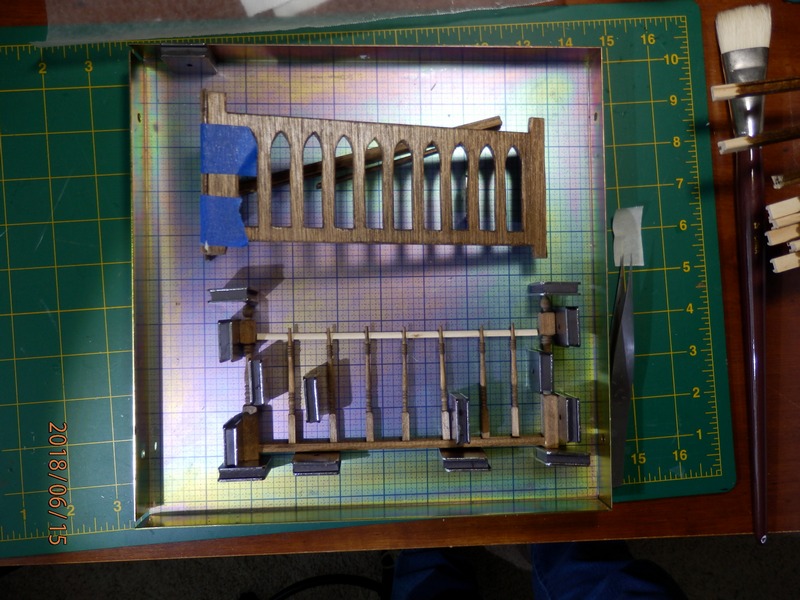
The tower roof got attention while I was waiting for the glue to dry on the upper floor stair railing. I'm using wood glue. I like that after a few minutes the glue holds the piece together but is supple enough to make micro adjustments. It eventually sets hard. Good glue. :)
This looks as if it is somewhat cattywampus, but the jig and the old railing are keeping it square. When it is time to put it into the house, a glue dot under each newel post should keep it in place. Another glue dot will adhere the middle floor stairway handrail to one of the newel posts and yet the whole unit will remain removable.
Somebody asked me why I am making the stairs removable. Good question. For one thing, the walls that the stairs are against will be impossible to decorate if the stairs are installed permanently. If I knew what is to go on those walls it wouldn't be a problem, but I'm still undecided. For another thing, it's the challenge. I'm stretching my bashing muscles on this one, for sure!

Edit: Adding photos of finished top floor railing.

The top floor railing is out of the jig and in place. (Ignore the dust on the floor. It's going to be covered with hardwood eventually.) 

The middle stairs and top floors railing are finished. Next up is the railing for the middle floor. Can't have little people falling through!


Beacon Hill Staircase Makeover [Step 6 ~ Bottom Stairs & Upper Railing]


Two orders arrived from miniatures.com (HBS), so work on the staircase is progressing. I very cleverly sliced a wee bit from the top of the staircase to allow for parquet flooring. The good doctor is pleased to see progress. He likes the sample of stained parquet. The foyer will be elegant when finished. I don't think he has noticed a couple of engineering issues that need to be resolved.

The staircase slides in and out rather nicely now, and the plan to handle the baluster issue is pretty much resolved. BUT ... in looking at the photo, another issue appears: how to slide it past the trim that will be on the doorway to the left. It will be impossible to twist it enough to clear the trim.

Removal of a slice from the section at upper right would move it far enough to the right to slide past the doorway, but when it is in place there would be a gap between the lower part of the staircase and the left wall. Something to ponder ... a strategically place bit of greenery? Maybe a piece of stripwood the same depth as the door trim and attached to the wall will blend in with the wood of the staircase. I don't believe the slight gap between the landing and the wall will be noticeable. If is is, a piece of baseboard/skirting on the wall would probably do the trick.

Hmm ... but now I see another problem: the upper right section will have to be trimmed to allow it to slide in along the cove moulding on the right wall. 

Have you noticed the Contractor is missing from this photo? I think he's in hiding.

Meanwhile, the railing that surrounds the upper story staircase hole is in the magnetic gluing jig. The piece at top is the kit solution. The balusters in the lower piece and the railing they stand on are glued. The light piece of quarter-round is raising the tip of the balusters so as to keep them horizontal. When the glue sets, the handrail will be glued in place. The balusters may be a tad bit far apart, but what did the Victorians know about OSHA? I think it will be aesthetically pleasing. 


Wednesday, June 13, 2018

Beacon Hill Staircase Makeover [Step 5 ~ Bottom stair begun]


The ground floor staircase has a bit of simple decoration. The panel inserts had 90-degree edges. I like them better beveled. All it took was a sharp eXacto knife and a little patience.

The inner panels edges have been beveled. The bit of quarter round taped in place is auditioning to see if edging the entire section would look better; it didn't make the cut. This view shows the wide balusters that are part of the kit. They will be replaced with the more delicate balusters like those used on the middle floor staircase.
Here are the beveled panels stained. I wish the grain of the wood were not so evident, but when it is installed in the house, I don't believe it will be as noticeable. 

And let the demolition begin! I started to saw off the balusters but realized quickly that the Easy Cutter would do a quicker and neater job of it. A little sanding and some stain, and the new balusters can be installed.
You can see how the balusters on the far side are truncated so the entire unit can slice in and out of the ground floor foyer. I haven't quite figured out how this can be accomplished with the new balusters. It may be that they will be attached to the handrail instead of the tread to become part of the middle floor railing unit. Still pondering this.
A little bonus: a set of wooden spoons turned up on the Greenleaf Dollhouse forum the other day. It inspired me to make a set for the Pierce/Bohemian Inn kitchen.
Here is the result of my first 1:12 attempt with its full size counterpart. The full size spoon was made by my father many years ago and is used frequently in my real life kitchen. The mini looks awfully small beside the full size spoon, but it is one inch long and the full size spoon is 12 inches long. (I just went back into the craft room and measured them to be sure!)

This closeup reveals the slight lopsidedness of the bowl. I used a couple very sharp eXacto knives, the carving tool in the photo above, and an emery board to get this far. A popsicle stick I happened to have on hand provided the wood; it has a nice, tight grain. A bit of paint will give it an aged, well used look.

In looking back over the file, I realized the Pierce was begun seven years ago, hibernated for two years, and after a brief spurt of effort has hibernated again for the past five years.  Poor Pierce. It's time to get the Beacon Hill finished so I can move on!